D1 Security and Risk Management
By:
Prasanna
|
Domain 1 Cheat Sheet
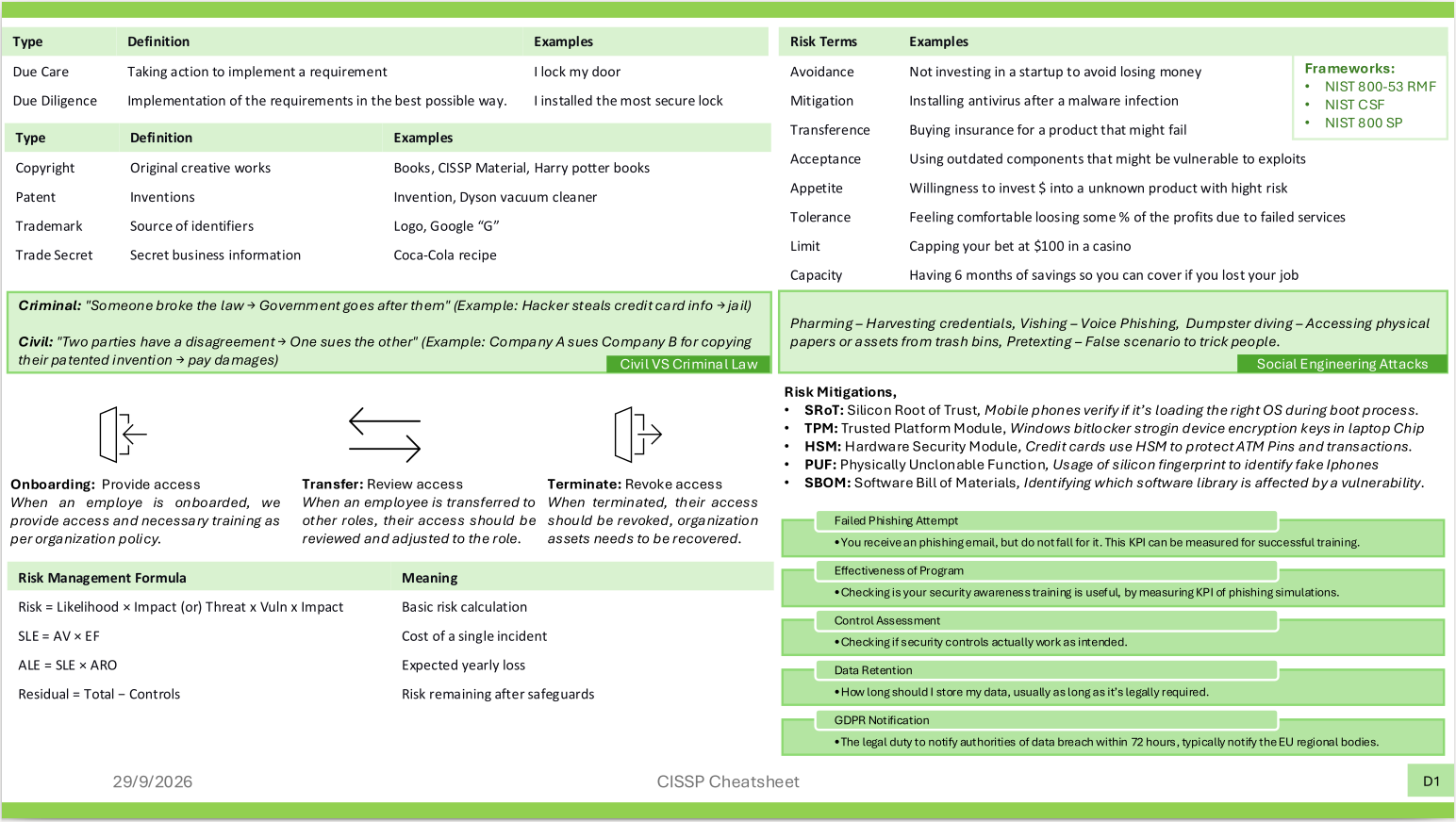
Due Care & Due Diligence
| Type | Definition | Examples |
|---|---|---|
| Due Care | Taking action to implement a requirement | I lock my door |
| Due Diligence | Implementation of the requirements in the best possible way | I installed the most secure lock |
Intellectual Property
| Type | Definition | Examples |
|---|---|---|
| Copyright | Original creative works | Books, CISSP Material, Harry Potter books |
| Patent | Inventions | Invention, Dyson vacuum cleaner |
| Trademark | Source of identifiers | Logo, Google “G” |
| Trade Secret | Secret business information | Coca-Cola recipe |
Criminal vs Civil Law
| Type | Description | Example |
|---|---|---|
| Criminal | “Someone broke the law → Government goes after them” | Hacker steals credit card info → jail |
| Civil | “Two parties have a disagreement → One sues the other” | Company A sues Company B for copying their patented invention → pay damages |
Employee Access Lifecycle
| Phase | Action |
|---|---|
| Onboarding | Provide access. When an employee is onboarded, we provide access and necessary training as per organization policy |
| Transfer | Review access. When an employee is transferred to other roles, their access should be reviewed and adjusted to the role |
| Terminate | Revoke access. When terminated, their access should be revoked, organization assets needs to be recovered |
Risk Management Formula
| Formula | Meaning |
|---|---|
| Risk = Likelihood × Impact (or) Threat × Vuln × Impact | Basic risk calculation |
| SLE = AV × EF | Cost of a single incident |
| ALE = SLE × ARO | Expected yearly loss |
| Residual = Total − Controls | Risk remaining after safeguards |
Risk Terms
| Term | Definition | Example |
|---|---|---|
| Avoidance | Not investing in a startup to avoid losing money | Not investing in a startup to avoid losing money |
| Mitigation | Installing antivirus after a malware infection | Installing antivirus after a malware infection |
| Transference | Buying insurance for a product that might fail | Buying insurance for a product that might fail |
| Acceptance | Using outdated components that might be vulnerable to exploits | Using outdated components that might be vulnerable to exploits |
| Appetite | Willingness to invest $ into unknown product with high risk | Willingness to invest $ into unknown product with high risk |
| Tolerance | Feeling comfortable losing some % of profits due to failed services | Feeling comfortable losing some % of profits due to failed services |
| Limit | Capping your bet at $100 in a casino | Capping your bet at $100 in a casino |
| Capacity | Having 6 months of savings so you can cover if you lost your job | Having 6 months of savings so you can cover if you lost your job |
Frameworks
- NIST 800-53 RMF
- NIST CSF
- NIST 800 SP
Social Engineering Attacks
| Attack | Description |
|---|---|
| Pharming | Harvesting credentials |
| Vishing | Voice Phishing |
| Dumpster Diving | Accessing physical papers or assets from trash bins |
| Pretexting | False scenario to trick people |
Risk Mitigations (Technical Controls)
| Control | Purpose |
|---|---|
| SRoT (Silicon Root of Trust) | Mobile phones verify if it’s loading the right OS during boot process |
| TPM (Trusted Platform Module) | Windows BitLocker storing device encryption keys in laptop chip |
| HSM (Hardware Security Module) | Credit cards use HSM to protect ATM PINs and transactions |
| PUF (Physically Unclonable Function) | Usage of silicon fingerprint to identify fake iPhones |
| SBOM (Software Bill of Materials) | Identifying which software library is affected by a vulnerability |
Security Awareness KPIs
| KPI | Purpose |
|---|---|
| Failed Phishing Attempt | You receive a phishing email, but do not fall for it. This KPI can be measured for successful training |
| Effectiveness of Program | Checking if your security awareness training is useful, by measuring KPI of phishing simulations |
| Control Assessment | Checking if security controls actually work as intended |
| Data Retention | How long should I store my data, usually as long as it’s legally required |
| GDPR Notification | The legal duty to notify authorities of data breach within 72 hours, typically notify the EU regional bodies |