D2 Asset Security
By:
Prasanna
|
Domain 2 Cheat Sheet
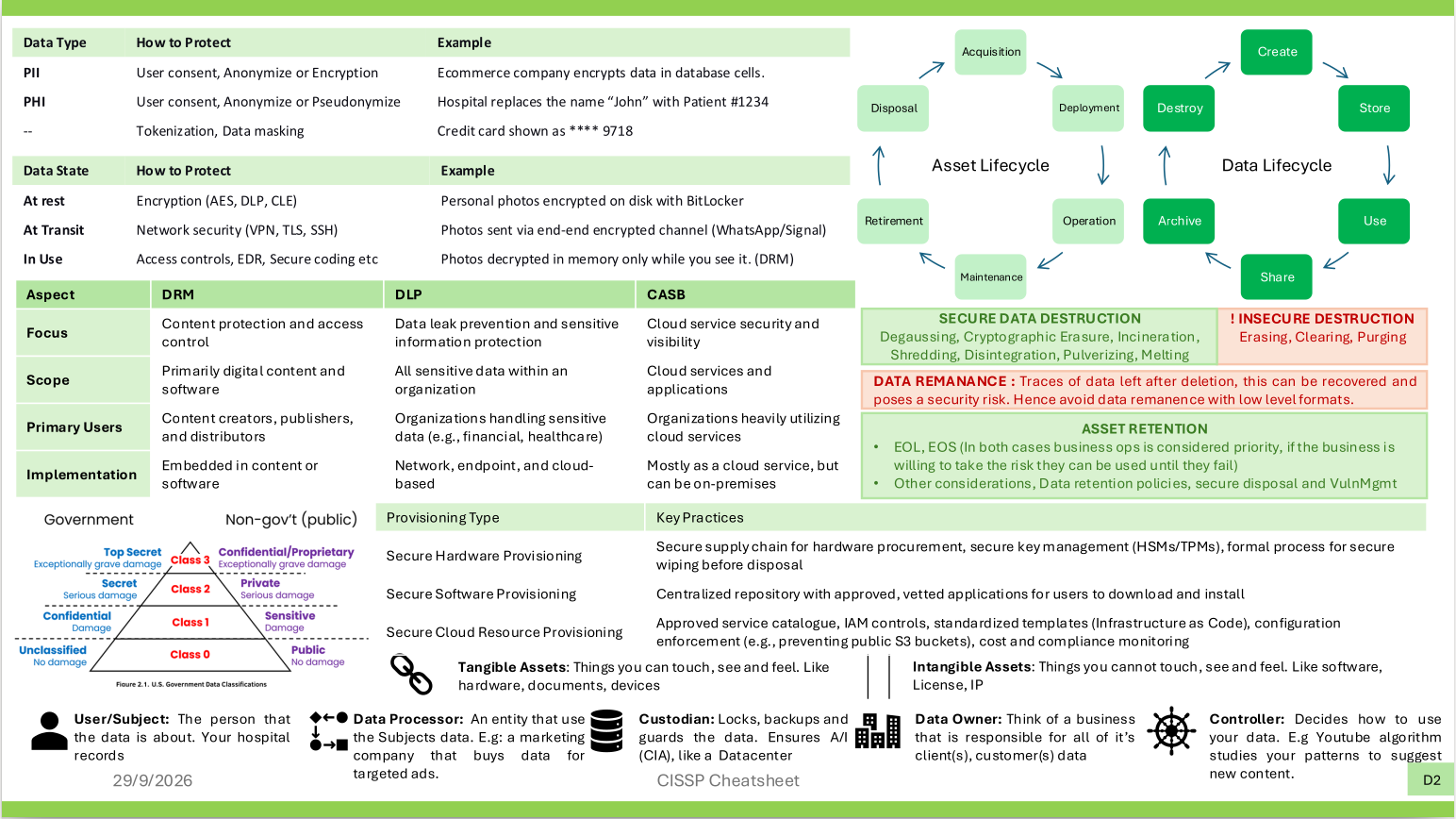
Data Roles & Responsibilities
| Role | Definition | Example |
|---|---|---|
| Data Owner | Think of a business that is responsible for all of its client(s)/customer(s) data | Business responsible for customer data |
| User/Subject | The person that the data is about | Your hospital records |
| Data Processor | An entity that uses the Subject’s data | A marketing company that buys data for targeted ads |
| Custodian | Locks, backups and guards the data. Ensures A/I (CIA), like a Datacenter | Datacenter protecting data |
| Controller | Decides how to use your data | YouTube algorithm studies your patterns to suggest new content |
Data States & Protection
| Data State | How to Protect | Example |
|---|---|---|
| At Rest | Encryption (AES, DLP, CLE) | Personal photos encrypted on disk with BitLocker |
| In Transit | Network security (VPN, TLS, SSH) | Photos sent via end-to-end encrypted channel (WhatsApp/Signal) |
| In Use | Access controls, EDR, Secure coding etc | Photos decrypted in memory only while you see it (DRM) |
Secure Data Destruction
| Method | Classification |
|---|---|
| ⚠️ INSECURE DESTRUCTION | Erasing, Clearing, Purging |
| ✅ SECURE DATA DESTRUCTION | Degaussing, Cryptographic Erasure, Incineration, Shredding, Disintegration, Pulverizing, Melting |
Asset Retention
| Consideration | Details |
|---|---|
| EOL/EOS (End of Life/End of Support) | In both cases business ops is considered priority; if the business is willing to take the risk they can be used until they fail |
| Other Considerations | Data retention policies, secure disposal and Vulnerability Management |
DRM vs DLP vs CASB
| Aspect | DRM | DLP | CASB |
|---|---|---|---|
| Focus | Content protection and access control | Data leak prevention and sensitive information protection | Cloud service security and visibility |
| Scope | Primarily digital content and software | All sensitive data within an organization | Cloud services and applications |
| Primary Users | Content creators, publishers, and distributors | Organizations handling sensitive data (e.g., financial, healthcare) | Organizations heavily utilizing cloud services |
| Implementation | Embedded in content or software | Network, endpoint, and cloud-based | Mostly as a cloud service, but can be on-premises |
Data Remanence
Definition: Traces of data left after deletion, this can be recovered and poses a security risk. Hence avoid data remanence with low level formats.
Asset Types
| Type | Description | Examples |
|---|---|---|
| Tangible Assets | Things you can touch, see and feel | Hardware, documents, devices |
| Intangible Assets | Things you cannot touch, see and feel | Software, License, IP |
Secure Provisioning
Secure Hardware Provisioning
- Secure supply chain for hardware procurement
- Secure key management (HSMs/TPMs)
- Formal process for secure wiping before disposal
Secure Software Provisioning
- Centralized repository with approved, vetted applications for users to download and install
Secure Cloud Resource Provisioning
- Approved service catalogue
- IAM controls
- Standardized templates (Infrastructure as Code)
- Configuration enforcement (e.g., preventing public S3 buckets)
- Cost and compliance monitoring