D4 Communication and Network Security
By:
Prasanna
|
Domain 4 Cheat Sheet
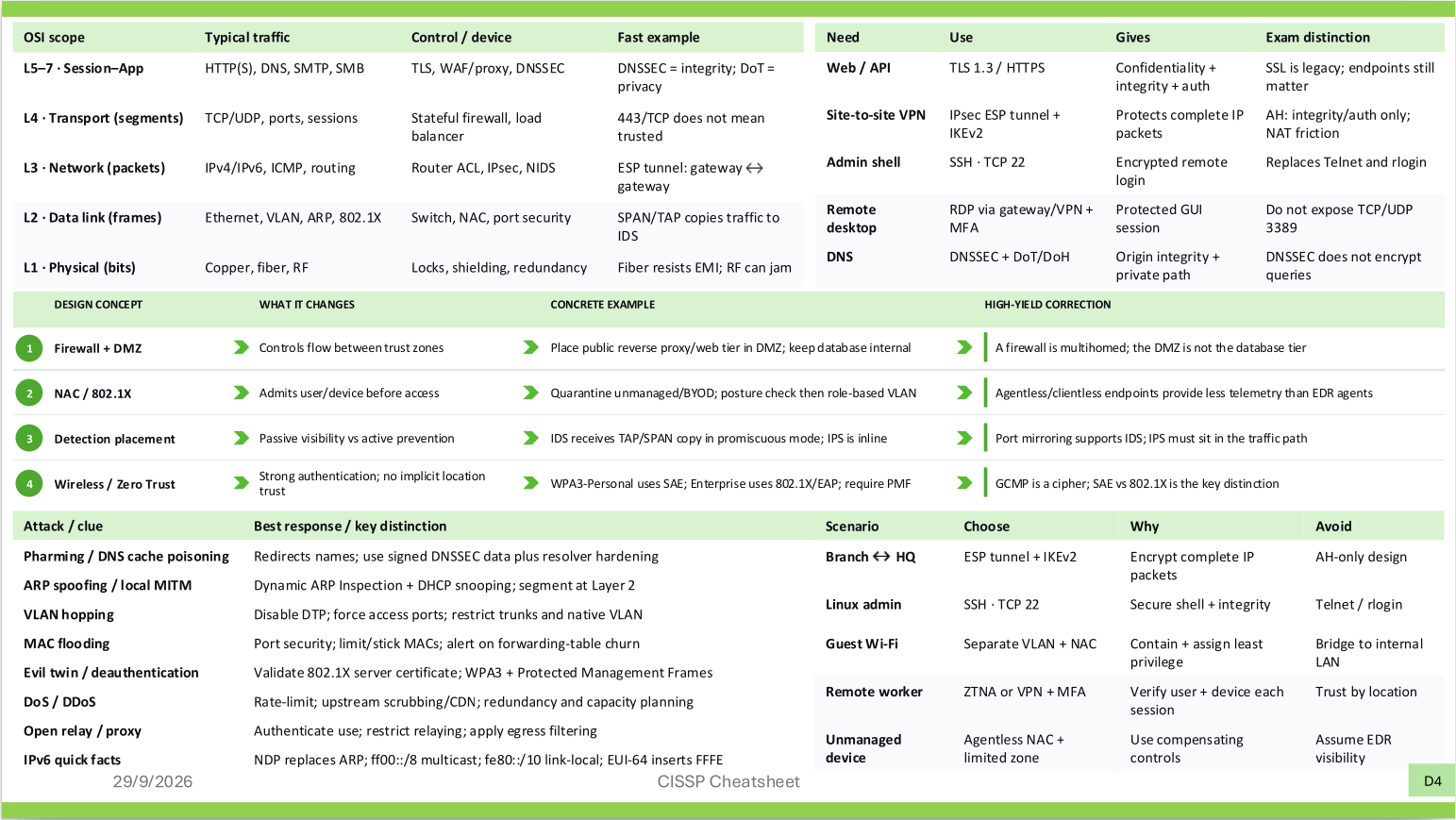
Design Concepts
| Design Concept | What It Changes | Concrete Example | High-Yield Correction |
|---|---|---|---|
| Firewall + DMZ | Controls flow between trust zones | Place public reverse proxy/web tier in DMZ; keep database internal | A firewall is multihomed; the DMZ is not the database tier |
| NAC / 802.1X | Admits user/device before access | Quarantine unmanaged/BYOD; posture check then role-based VLAN | Agentless/clientless endpoints provide less telemetry than EDR agents |
| Detection Placement | Passive visibility vs active prevention | IDS receives TAP/SPAN copy in promiscuous mode; IPS is inline | Port mirroring supports IDS; IPS must sit in the traffic path |
| Wireless / Zero Trust | Strong authentication; no implicit location trust | WPA3-Personal uses SAE; Enterprise uses 802.1X/EAP; require PMF | GCMP is a cipher; SAE vs 802.1X is the key distinction |
Secure Communications — Tunneling Is Not the Same as Encryption
| Protocol | Description |
|---|---|
| Browser → Server | TLS protects application traffic; validate the server certificate |
| Key Establishment | Diffie–Hellman derives a shared secret; it does not authenticate by itself |
| Bulk Encryption | AES protects the session data efficiently after the key is established |
| GRE / L2TP | GRE encapsulates using an outer destination IP; L2TP tunnels PPP. Neither means “encrypted.” |
| IPsec ESP | ESP adds confidentiality, integrity/authentication and anti-replay options |
HIGH-YIELD: Symmetric crypto is computationally efficient; asymmetric crypto solves identity/key-establishment problems. Out-of-band exchange can bootstrap a shared secret.
Penetration Testing Types
| Type | Description |
|---|---|
| Black Box | Tester has no prior knowledge of the target environment |
| Grey Box | Tester has partial knowledge of the target environment |
| White Box | Tester has complete knowledge of the target environment |
Penetration Testing Guidelines
| Listed Concept | Required Action | Why It Matters |
|---|---|---|
| Evidence of a Real Incident | Pause the affected test activity and notify the named contact in the rules of engagement | Avoid contaminating evidence or worsening an active compromise |
| Stay Within Authorization | Do not investigate beyond approved scope unless formally authorized | A tester is not automatically the incident-response team |
| Preserve Test Steps | Keep timestamps, commands, screenshots, payload hashes and affected assets | Supports reproducibility, accountability and the final report |
| Do Not Erase Proof | Retain testing records and evidence; do not conceal exploitation activity | Deleting traces destroys the audit trail and can look malicious |
| Controlled Cleanup | Remove test accounts/files and restore changes only as agreed—while preserving records | Returns systems safely without losing evidence |
Alert Fatigue Clues
| Clue | Meaning / Response |
|---|---|
| Duplicate Alerts | Group 500 repeats into one incident |
| Poor Thresholds | Baseline normal activity, then tune the rule |
| No Context | Add user, asset criticality, vulnerability and threat data |
| Manual Overload | Automate safe enrichment and known-benign closure |
| Tuning Risk | Do not just disable noise; measure false positives and misses |
SOC 3 Report Aspects
| SOC 3 Aspect | What It Means | Example | Exam Distinction |
|---|---|---|---|
| Audience | General-use report for broad audiences | A restaurant displays a hygiene certificate for any customer to see | SOC 3 is suitable for public distribution |
| Content Level | High-level assurance, not detailed control test results | A report card shows “passed,” not every answer sheet | Less detail than a restricted-use SOC 2 report |
| Purpose | Communicate assurance over relevant trust services criteria | Cloud provider posts an assurance report on its website | It is an attestation report—not a penetration-test report |
| Distribution | May be shared publicly without the restricted audience of SOC 2 | A public brochure versus a confidential auditor binder | Public disclosure clue → SOC 3 |
| Selection Clue | Choose when customers need public assurance | Prospect wants proof before signing up, but no sensitive details | Detailed control evidence → ask for the appropriate SOC 2 report |
Configuration Management Tools
| Tool | Transport / Port | Model |
|---|---|---|
| Puppet | TCP 8140 by default | Agent checks in with server |
| Ansible | SSH · TCP 22 by default | Agentless push |
| Salt | ZeroMQ · TCP 4505/4506 | Master publishes; minions return data |
| Chef | HTTPS · TCP 443 | Client pulls recipes/policies |
KPI vs KRI Comparison
| Aspect | KPI (Key Performance Indicator) | KRI (Key Risk Indicator) |
|---|---|---|
| Purpose | Performance & success | Potential risks & threats |
| Time | Past / current | Predict future risk |
| Trigger | Improve performance | Mitigate risk |
| Overlap | Same metric can serve both | Phishing fail rate |
| Influence | KRI shifts strategy | KPI tunes thresholds |
| Reporting | Program effectiveness | Internal risk decisions |
Penetration Testing Process
Reconnaissance → Enumeration → Vuln Analysis → Exploitation → Reporting